The Plate That Could Not Be Finished
If you have ever been a guest at a traditional Indian wedding feast, you already know what happens.
You sit down on a long strip of mat with dozens of other guests. A plate made of leaves is placed in front of you. And then they come, one after another, the servers with their steel buckets and their big serving spoons. Hot fried bread. Rice. Lentils. Two kinds of vegetables. A tangy yogurt curry. Cool yogurt. Crisp wafers. Pickle. Then the sweets: syrupy dumplings, golden pearls of fried gram flour, and something orange and glistening that nobody can quite name.
You eat. You eat well. You enjoy it. And then, when you are already full, the servers come round again.
“One more?”
“No, that’s enough.”
“Come on, just one.”
Nobody wins this argument. You can put your hand flat over your plate. You can shake your head. You can say “enough, enough” until your voice gives out. Somehow, when you look down, there is another piece of bread on the leaf.
By the end of the meal, many guests find themselves sitting in front of a plate that is fuller than when they started, with a stomach that has no more room. And with that comes a small, familiar guilt. Across India, children grow up hearing that wasting food is disrespectful, because food is sacred. You finish what is on your plate.
So the guest sits there, unable to eat any more and unwilling to leave it, feeling slightly sick and slightly ashamed, while the music starts up outside.
It is a funny scene. It is also a very good picture of the way most of us live.
The Servers Who Never Stop
Think about your own plate for a moment. Not the one on your dining table. Your life.
Every day, the servers come round. Messages. News. Work. The expectations of family. Other people’s opinions about your weight, your job, your marriage, your children. The quiet comparisons. The arguments that were never finished. The losses there was no time to grieve. The fears about money, about health, about whether you are doing any of this right.
Nobody asks whether you are hungry. They simply keep serving.
And you, like a polite guest, keep taking it. Sometimes you put your hand over the plate. Sometimes you say “enough.” But somehow, when you look down, there is always more.
So you carry it. A grudge from three years ago. A sentence a parent said when you were twelve. A failure you still think about while brushing your teeth. A loss you have never fully cried about. An endless stream of images of people who seem happier, thinner, richer and more certain than you.
None of it has been digested. It is all simply sitting there on the leaf, going cold.
And then we wonder why we feel so heavy.
What This Book Is About
This is a book about digestion. Real digestion, of real food, the kind your stomach does every day. And also the other kind, the kind your mind and heart are meant to do with everything life serves you.
Ayurveda, the traditional medical science of India, has a simple and profound idea at its centre. Inside each of us burns a fire, called agni. This fire takes whatever we take in and transforms it. What nourishes us becomes our strength. What does not is released. When the fire is strong, we feel light, clear and hungry for life. When it is weak or disturbed, things that should have been transformed are left behind, half-cooked, heavy and sticky. Ayurveda calls this residue ama, and it treats ama as the beginning of a great deal of suffering.
The old teachers of India understood that this is not only true of food. They taught that we take in the world through all our senses, and that every experience is a kind of meal. A conversation is a meal. A loss is a meal. A failure is a meal. Each one has to be properly digested, or it stays inside us, quietly making us heavy.
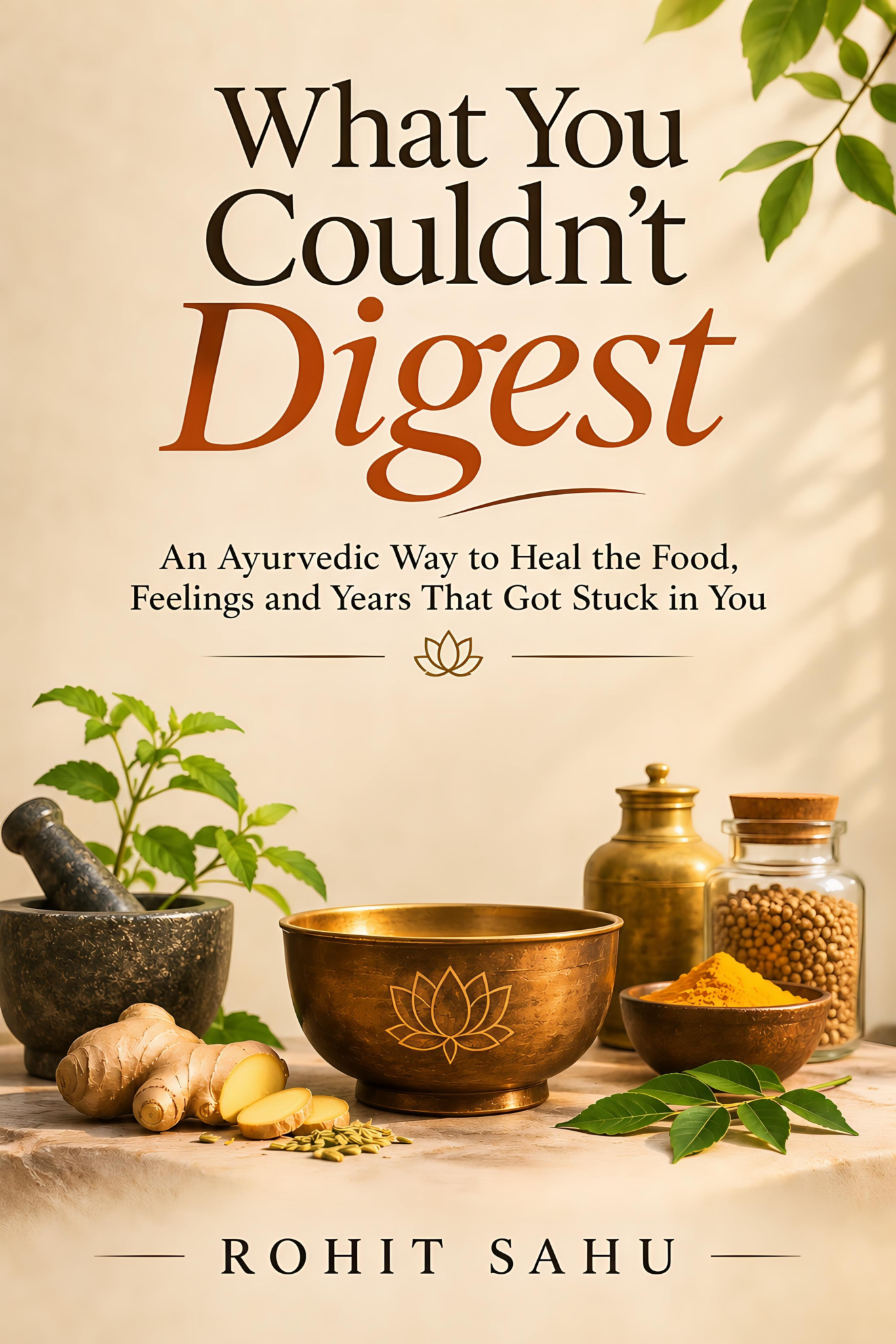
That is why this book is called What You Couldn’t Digest. Not because something is wrong with you. But because almost all of us are carrying plates we could not finish.
What This Book Is, and What It Is Not
This book is a companion. Think of it as a long, unhurried conversation with a friend who has spent years with the old texts of Ayurveda and Indian spirituality, and who wants to share what is useful in them, plainly and honestly.
You will find the teachings of the classical Ayurvedic physicians, Charaka, Sushruta and Vagbhata. You will find verses from the Bhagavad Gita, the Upanishads and the Yoga Sutras of Patanjali. You will find the plain-spoken wisdom of poets like Kabir and Thiruvalluvar, and old stories from the Mahabharata, the Panchatantra and the village storytellers of India. And you will find what modern science is beginning to discover about the same questions. Sometimes the old and the new agree beautifully. Sometimes the science is still catching up, and where that is the case, this book will say so honestly.
This book is not a diet plan. It will not tell you to give up everything you enjoy or to follow a strict list of rules. It is not a promise of miracles, and it is not a substitute for medical care. Ayurveda itself has always held that knowing when to seek help is part of wisdom, and every chapter carries a short note to remind you of that.
What this book offers is a different way of looking at your life, and a handful of small, practical things to try.
How to Read This Book
The book is divided into four parts.
In Part One, The Fire Inside, we explore agni: what it is, the four ways it can burn, and what happens when it leaves things behind.
In Part Two, What Gets Stuck, we look honestly at the things most of us fail to digest: the meals eaten in anger, the words we swallow, the grief we postpone, the failures we keep chewing, and the endless input we pile on before the last meal has even settled.
In Part Three, Rekindling the Fire, we learn how to make the fire strong again, through emptiness, through closing the gap between knowing and doing, and through living in step with the natural rhythms of the day and the seasons.
In Part Four, Becoming Whole, we arrive at what all of this is really for: ojas, the radiant essence that remains when everything has been well digested, and swastha, the Ayurvedic word for health, which literally means being established in your own self.
Each chapter follows a gentle pattern. It begins with a story or a picture from ordinary life. It explains what Ayurveda says. It explores the deeper spiritual teaching beneath it. It offers one or more small practices, most of which take only a few minutes a day. And it ends with a short section called Between Friends, which holds the one thing most worth carrying away.
You can read the book straight through, and that is the best way the first time, because each chapter builds on the last. Afterwards, you can return to any chapter whenever its subject is the thing sitting heaviest on your plate.
Please do not try every practice at once. That would be exactly the kind of overeating this book warns against. Take one. Try it for a week. Notice what happens. Then take another.


Reviews
There are no reviews yet.