Have you noticed that you feel rushed even on days when nothing is urgent?
There is no deadline. No one is waiting for you. The day is open. And yet something inside keeps pushing. You eat quickly. You walk quickly. You read the first two lines of something and skip to the end. Even your rest feels hurried, as if you have to relax fast so you can get back to whatever comes next.
This is one of the quietest problems of modern life, and one of the most common. We assume the hurry comes from our schedule. So we try to fix the schedule: better planning, better apps, fewer commitments. Sometimes that helps for a while. But very often the hurry stays, even when the calendar is empty.
That is because the hurry was never really in the calendar. It is inside us.
The wisdom traditions of the East noticed this a very long time ago. They did not speak of time management. They spoke of the restless mind, the mind that is always leaning forward, always somewhere other than where the body is. And they offered a simple, radical answer: not to do more things faster, but to learn to be fully present in whatever you are already doing.
This post is about that answer. Where the inner hurry comes from, what it quietly costs us, and how to return, step by step, to a slower and more peaceful way of living.
The hurry is not in your calendar
Imagine two people with exactly the same day. Same work, same errands, same number of hours.
The first moves through the day like someone running for a train that has already left. Every task is something to get through. Every conversation is slightly impatient. By evening, they are exhausted, and they cannot remember much of what happened.
The second moves through the same day at the same pace on the outside, but something on the inside is different. When they are writing an email, they are writing an email. When they are drinking tea, they are drinking tea. They are not slower. They are simply here. By evening, they are tired, but it is a clean tiredness, the kind that comes after honest work, not the kind that comes after a day of fighting yourself.
The difference between these two people is not time. It is attention. One is always living in the next moment. The other is living in this one.
This is good news, because it means you do not have to wait for a quieter life to feel calmer. You can begin to change the inner pace in the middle of the life you already have.
Where the inner hurry comes from
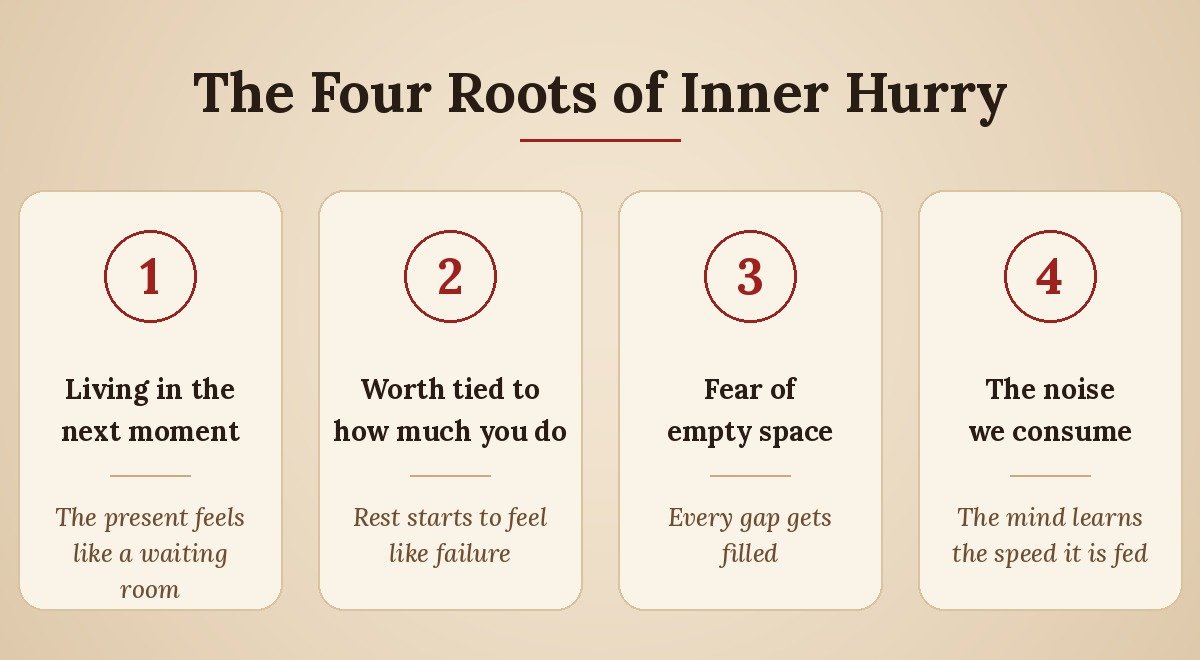
Before we can soften the hurry, it helps to understand its roots. In most of us, it grows from four places.
1. Living in the next moment
The mind has a habit of treating the present as a waiting room. Real life, it believes, will begin a little later: after this task, after this week, after this goal is reached. So the present moment is always something to rush through on the way to somewhere better.
The trouble is that the “somewhere better” never arrives. When the next moment comes, the mind simply leans toward the one after that. A whole life can be spent waiting to arrive.
2. Tying your worth to how much you do
Many of us learned early that we were valued for what we achieved. Good marks, good results, a full day. Slowly, without noticing, we began to believe that our worth depends on our output. A slow day starts to feel like a wasted day, and a wasted day feels like a small failure.
When your sense of worth depends on productivity, rest becomes uncomfortable. Stillness feels like falling behind. So you keep moving, not because the work needs it, but because stopping feels unsafe.
3. Fear of empty space
Notice what happens when you have a spare minute: in a queue, waiting for someone, sitting alone after a meal. For most of us, the hand reaches for the phone almost automatically.
We fill every gap because empty space can feel uncomfortable. In the quiet, feelings we have been avoiding start to rise. Thoughts we have not finished thinking come back. Hurry is a very effective way of never having to sit with ourselves.
4. The noise we consume
The mind becomes what it is fed. If it is fed a constant stream of fast videos, alerts, headlines and opinions, it learns to move at that speed. It grows impatient with anything slower: a long conversation, a book, a quiet walk, an ordinary afternoon.
We often blame ourselves for being restless, when in truth we have simply been training restlessness, hour by hour, without meaning to.
What the hurry quietly costs you
Hurry rarely announces its price. It takes things from us slowly, so slowly that we hardly notice.
It takes your life while you are living it. When you are always half-somewhere-else, you miss the actual moments that make up your days. The taste of food, the face of the person speaking to you, the light in the evening sky. You are present for the events of your life, but not for the experience of them.
It takes depth from your relationships. People can feel when you are listening only to reply, or listening while waiting to leave. Love needs unhurried attention the way a plant needs water. Without it, even close bonds slowly dry out.
It takes peace from your body. A hurried mind keeps the body on alert: shallow breathing, tight shoulders, a clenched jaw, a stomach that never quite settles. Over months and years, this constant low-level tension becomes exhaustion that sleep alone cannot fix.
It takes clarity from your decisions. Wisdom needs space. When you are rushing, you react instead of respond. You say yes when you mean no. You choose what is quick over what is right.
Stillness is not stopping
When people hear the word stillness, they often imagine giving everything up and sitting on a mountain. That is not what the old teachers meant.
There is a well-known story of a student who asked an old master what the secret of his peace was. The master replied, “When I walk, I walk. When I eat, I eat. When I sleep, I sleep.”
The student was puzzled. “But everyone does that,” he said.
The master smiled. “No,” he said. “When you sit, you are already standing up. When you stand up, you are already walking. When you walk, you have already arrived.”
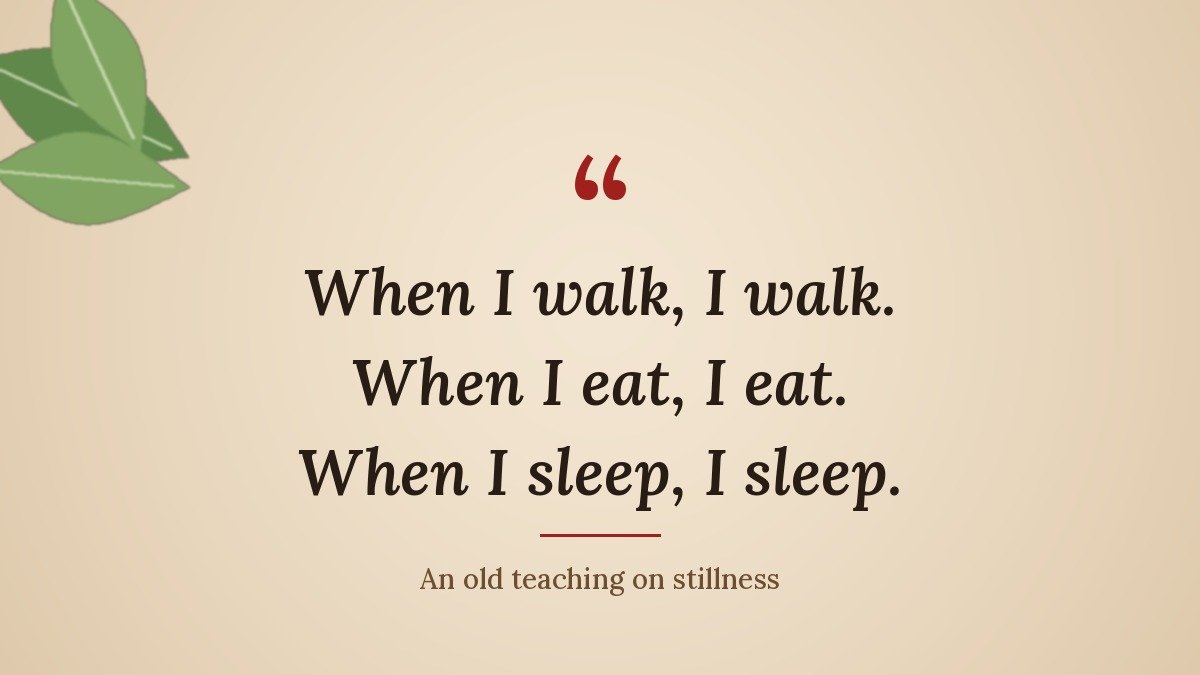
This is the whole teaching in a few lines. Stillness is not the absence of activity. It is the absence of inner rushing. You can be very busy and still be at peace, as long as you are fully inside what you are doing. And you can be sitting perfectly still, doing nothing at all, while your mind races a hundred miles ahead.
Stillness, in this sense, is not something you have to find time for. It is a way of meeting the time you already have.
Seven ways to return to stillness
None of these practices need special equipment or extra hours. They work best when done gently, a little every day, without turning them into another thing to achieve.
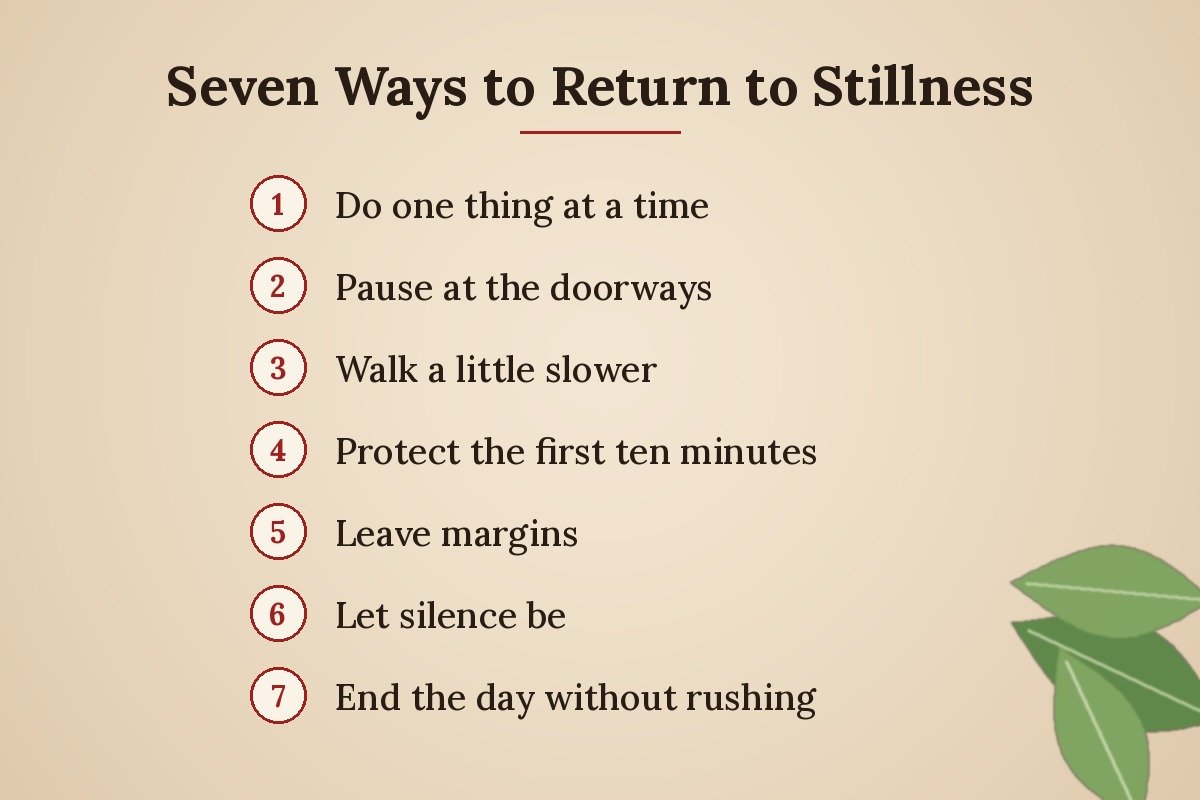
1. Do one thing at a time
Choose one ordinary activity each day and give it your full attention. Washing dishes. Drinking your morning tea. Brushing your teeth. Notice the temperature, the sounds, the small movements of your hands. When your mind wanders to the next task, gently bring it back.
This sounds almost too simple. But it is how the mind slowly relearns that it is allowed to be here.
2. Pause at the doorways
Every time you walk through a door, let it be a small reminder to take one slow breath. Doorways mark the places where we move from one part of the day to the next, and they are exactly where the hurry likes to build. A single breath at each one is like opening a small window in a stuffy room.
3. Walk a little slower than you need to
When you are not truly late, try walking at eighty percent of your usual speed. Feel your feet touching the ground. Look around you. You will arrive only a few seconds later, but you will arrive as a different person: calmer, softer, more awake.
4. Protect the first ten minutes of the day
How you begin the morning often sets the pace for everything after it. If the first thing you do is reach for your phone, you hand your attention to the world before you have even met yourself.
Try keeping the first ten minutes free. Sit by a window. Drink a glass of warm water slowly. Breathe. Notice how you feel. Let the day come to you instead of chasing it.
5. Leave margins
Hurry often comes from planning a day with no room for life. Every hour is filled, so the smallest delay pushes everything into a rush.
Leave margins: ten minutes between commitments, a free hour in the afternoon, an evening with nothing planned. Margins are not wasted time. They are what allow the rest of your time to breathe.
6. Let silence be
Once a day, allow a small empty space to stay empty. Do not fill the queue, the wait or the walk with your phone. Just be there. Feelings may rise. Thoughts may chatter. Let them. Silence is not something to fix. It is something to get used to, like the eyes adjusting to the dark.
7. End the day without rushing into sleep
Before you sleep, sit for a moment and take three slow breaths. Then ask yourself two questions: When was I truly present today? and When was I rushing for no reason?
Do not judge the answers. Simply notice. Over time, this gentle review teaches the mind to recognise its own hurry, and recognising it is already half of letting it go.
When the hurry returns
It will return. Some days you will catch yourself racing through a meal, or snapping at someone you love, or scrolling without knowing why. This is not failure. It is simply the old habit doing what habits do.
The practice is not to never hurry again. The practice is to notice, a little sooner each time, and come back. Like a pendulum that swings away and returns to the centre, you will drift and return many times a day. Every return counts. Every return makes the next one easier.
Be patient with yourself in this. Rushing towards stillness is still rushing. Let even your peace arrive slowly.
You are not behind
Underneath the inner hurry, for most of us, lives a quiet fear: the feeling that we are behind. Behind others, behind where we should be, behind on life itself.
But life is not a race with a finish line somewhere ahead. It is happening right here, in this breath, in this room, in this moment of reading these words. There is nowhere you need to rush to in order to begin living it. You are already inside it.
So the next time you feel that familiar push inside, the one that says faster, faster, not yet, not here, try something different. Stop for a moment. Feel your feet on the ground. Take one slow breath. And remind yourself, gently:
I am not behind. I am here. And here is where my life is.